Five questions worth asking any aromatherapy school
Most people who enrol with us researched for months first. Some of them lurked on our Facebook page for two years. One took our free intro course in 2022 and signed up for the certification in 2025, and when we checked her record we both got a bit emotional about it.
That's normal, and it's smart. Aromatherapy certification is a real investment of money and about a year of your evenings. You should be picky.
So here are the five questions we'd ask if we were choosing a school today. We've deliberately written them so the answer isn't automatically us. Ask them of anyone you're considering, us included.
Who recognizes this certification, and what does that recognition actually get me?
"Certified" on its own doesn't mean much. There's no single licensing body for aromatherapy, so the credential is only as meaningful as the association standing behind it.
In Canada, the Canadian Federation of Aromatherapists (CFA) and the National Association for Holistic Aromatherapy (NAHA) are the two names worth knowing. Ask which one recognizes the course, at what level, and what you're entitled to call yourself when you finish.
Then ask the follow-up question, which most people don't: what do I actually do with that? Does it help with professional insurance? Do other practitioners recognize it? Is it something a client would understand?
For the record, our Clinical Aromatherapy Certification is CFA recognized as a Certified Aromatherapy Health Professional (CAHP) and NAHA Level 3 Certified Clinical Aromatherapist. Our 50-hour Foundations course is NAHA Level 1.
Who marks my work?
This is the question almost nobody asks, and it's the one we'd ask first.
Online education has quietly moved toward auto-grading. Multiple choice, instant score, next module. That works fine for a safety quiz. It falls apart completely on a case study, which is the assignment where you find out whether you can actually think like a practitioner.
So ask directly: is my case study read by a person? Which person? Can I ask them a follow-up question?
We mark every case study ourselves, both of us, every time. It's the slowest part of running this school and we've never seriously considered changing it.
How much chemistry is in it, and how is it taught?
Chemistry is the thing people are most frightened of and the thing that separates someone who knows a list of oils from someone who understands why an oil behaves the way it does.
Ask whether chemistry is a module or a mention. Ask how it's taught. Ask what happens if you get stuck.
We'll be honest that plenty of our students arrive convinced they'll fail this section. Nancy Lumbard, who hadn't been in a classroom since high school, got 93%. Dr. Kenneth Wallace had previously left a chemical engineering path because of organic chemistry, and got through ours fine. That's not a promise about your result. It's a reason not to let the fear make the decision for you.
Chemistry is the thing people are most frightened of and the thing that separates someone who knows a list of oils from someone who understands why an oil behaves the way it does.
Ask whether chemistry is a module or a mention. Ask how it's taught. Ask what happens if you get stuck.
We'll be honest that plenty of our students arrive convinced they'll fail this section. Nancy Lumbard, who hadn't been in a classroom since high school, got 93%. Dr. Kenneth Wallace had previously left a chemical engineering path because of organic chemistry, and got through ours fine. That's not a promise about your result. It's a reason not to let the fear make the decision for you.What happens when life gets in the way?
What happens when life gets in the way?
It will. Someone gets sick, a work project blows up, a kid needs you.
Ask what the completion window is. Ask whether extensions exist and what they cost. Ask whether the course is genuinely self-paced or whether there are live sessions you'll be penalized for missing.
Ours: up to two years to complete, a one-year extension available for a small fee, and no live attendance requirement anywhere. Average completion is around 13 months.
What happens after I graduate?
This is the second question nobody asks, and the one we'd want answered most.
A certificate is not a practice. The real work starts the week after you finish, when you have to figure out how to find a client, what to charge, and how to write an invoice without feeling like a fraud.
Ask whether the school stays in touch. Ask whether there's a community. Ask whether anyone will pick up the phone in eighteen months.
Ask these questions of us
We'd rather you asked and got a straight answer than enrolled somewhere on a hunch. If any of the five above are still open for you, email us at info@schoolofessentria.com and we'll answer them properly.
And if you'd rather just see how we teach before asking anyone anything, our Introduction to Aromatherapy course is free. Eight oil profiles, safe use, carrier oils, recipes. It's at schoolofessentria.com/en/free.
Running until Tuesday, September 15: enrol in the Clinical Aromatherapy Certification and the Business Foundations course ($249 CAD) is included free. The certification is $1,140 CAD, or three monthly payments of $418. Enrolment stays open year round, so the only thing that ends on the 15th is the bonus course..
LEARN MORE WITH ESSENTRIA

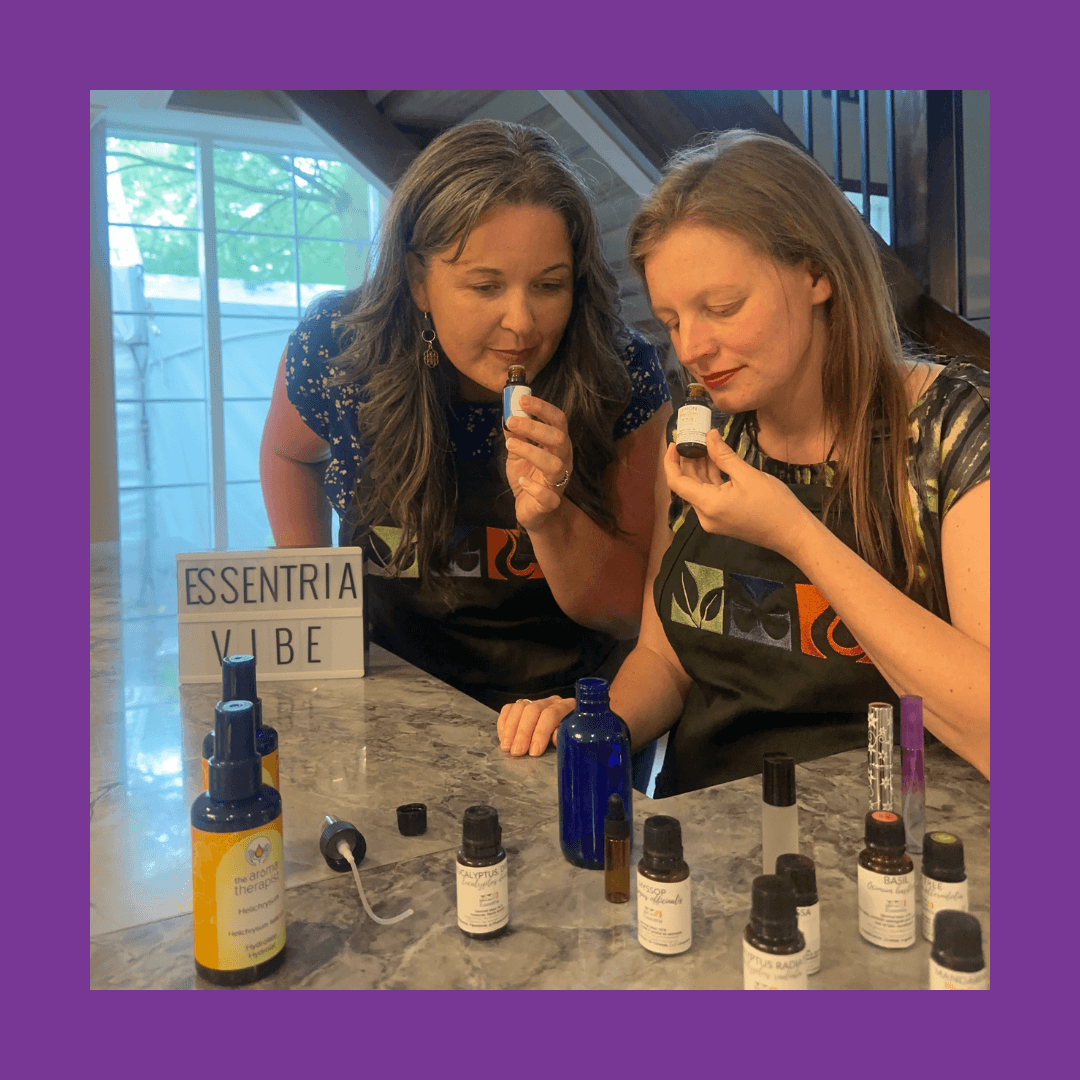
This information is brought to you by Nikki Fraser and Rachael Dean, Clinical Aromatherapists and co-founders of Essentria Aromatherapy School. With over 20 years of combined experience, and recognition from top organizations like NAHA and CFA, they are passionate about empowering others to use essential oils safely. At Essentria Aromatherapy School, they offer leading online courses, helping students gain confidence and credibility in the field of aromatherapy. Whether you're exploring essential oils for personal use or looking to build a fulfilling career, Nikki and Rachael are here to guide you every step of the way.
Want to learn more about how to use essential oils in your home? Check out our free no strings attached online course here.
Plus consider joining us in our Facebook group Love Essential Oils with Essentria where we post tips and tricks on how to use aromatherapy safely in your daily life.
Grab some FREE tools to help you on your essential oils journey.
Follow us for FREE educational and fun posts daily and don’t forget to subscribe to our newsletter for access to discounts and promos!
Want to learn more about how to become an aromatherapist, check out our certification courses and bundles offered online here.